
The schedule your auditor asks for, already built.
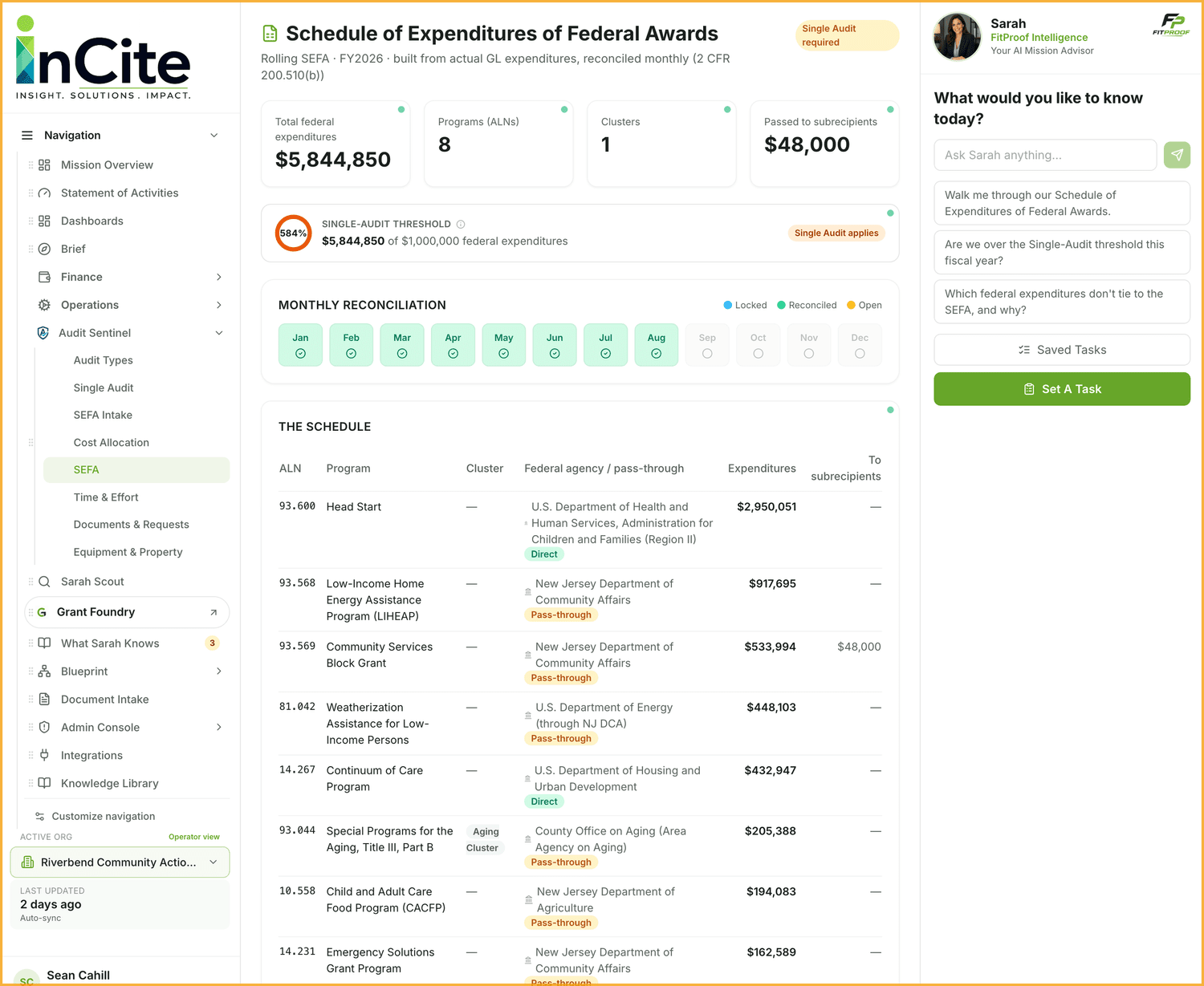
The Schedule of Expenditures of Federal Awards is normally assembled at audit time from spreadsheets and memory. InCite rebuilds it every night from actual general-ledger expenditures — not award totals — and reconciles it month by month, so the schedule is finished before fieldwork starts.
- Built from the ledger, not from award letters. One row per Assistance Listing Number and cluster, from posted expenditures — which is what the schedule is required to report.
- Direct and pass-through, told apart on evidence. Federal money arriving through a state or county agency is still federal, and appears with the pass-through entity named.
- The Single-Audit threshold, tracked live. You learn you have crossed $1,000,000 in month three, not at year end.
- Months close and lock. A reconciled month the CFO signs off is written once and never rewritten — the rest keep rebuilding nightly.
Schedule prepared per 2 CFR 200.510(b). Threshold per 2 CFR 200.501 for fiscal years beginning on or after October 1, 2024.
Your audit, protected all year long.
Nightly ledger scans across all 12 federal award requirement areas, with findings ranked by severity and confidence — each carrying the citation it rests on, so your team can check the reasoning rather than take it on faith.
- Continuous Single-Audit risk scanning — not a year-end scramble
- SAM.gov screening and Federal Audit Clearinghouse pulls built in
- Trial balance, GL, 990s and sampling packets generated on demand
- One-click resolution of the auditor’s request list

An advisor that reads your records, and shows its work.
Sarah answers from your own data alongside a curated library of federal regulation, GAAP guidance and 1,400+ real audit findings — and cites where each answer came from. When the record doesn’t support an answer, she says so rather than filling the gap.

A short list worth your time.
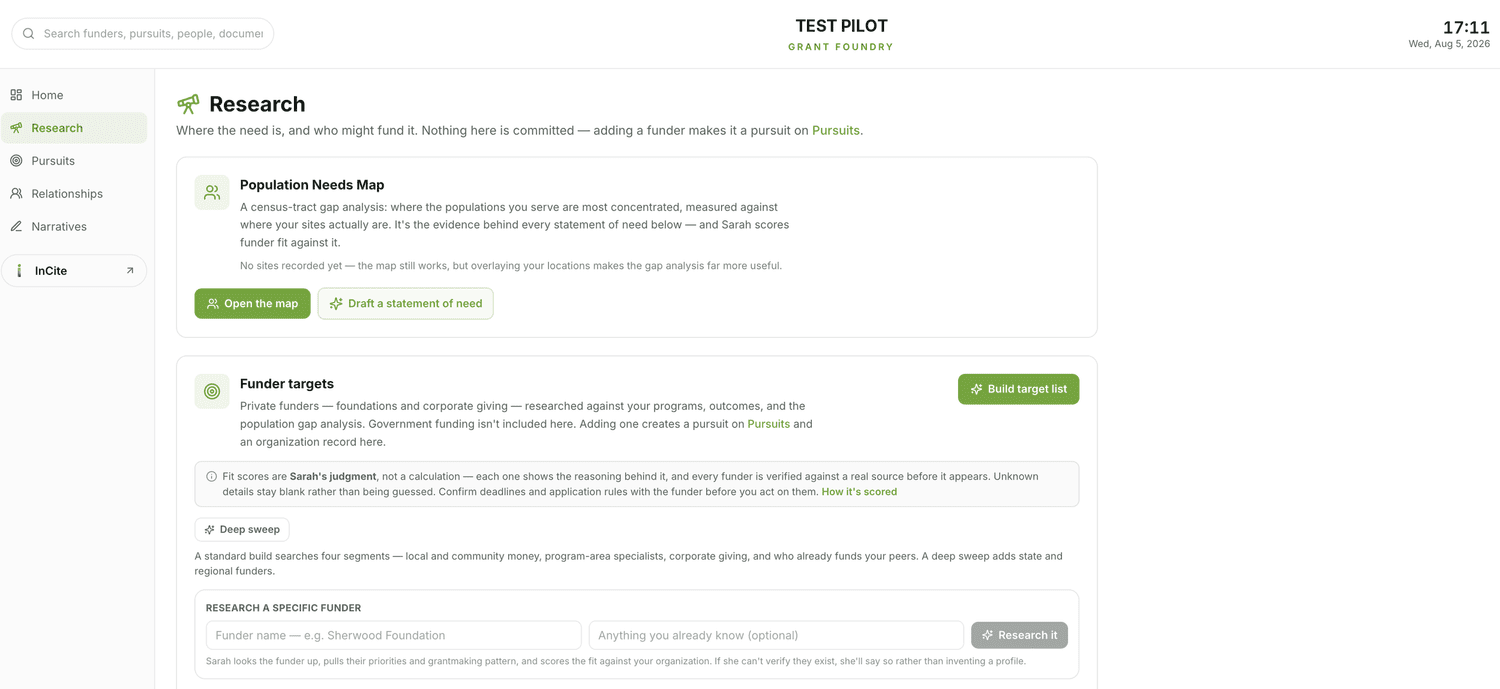
Most grant research ends in a spreadsheet of maybes nobody has time to work. Grant Foundry starts from the evidence of need — a census-tract gap analysis showing where the populations you serve are concentrated against where your sites actually are — and researches funders against your programs, your outcomes, and that gap.
- A targeted list, not a directory. Local and community money, program-area specialists, corporate giving, and who already funds your peers.
- Every score shows its reasoning. Each funder is verified against a real source before it appears, and unknown details stay blank instead of being guessed.
- A real first draft, built from your own documents. Where a fact is missing it brackets the gap and asks rather than inventing a number.
The CSBG cycle, kept as one connected record.
A Community Action Agency carries a reporting cycle few other nonprofits do: a community needs assessment, ROMA planning, the CSBG Annual Report, and 58 Organizational Standards. InCite holds them together — the assessment feeds the plan, the plan feeds the report, and the evidence for the standards comes from records you already keep.
Click a phase to see what it asks, the evidence that satisfies it, and the failure agencies most often make there.

Programs mapped to indicators, version by version.
Your programs are matched to the CSBG Annual Report indicators — services, individual and family outcomes, community outcomes — and every proposed match is confirmed by a person before it counts.
- Sarah proposes, your staff confirms. No mapping is assumed; each one shows the indicator’s own definition beside it.
- Version changes caught before filing. Where the report instrument retires an indicator, or reuses its code for something else, the change is flagged rather than carried forward silently.
- The methodology, on hand. ROMA guidance from OCS and the national partners sits in Sarah’s library and is cited when she answers.

Both halves of the assessment, with the gaps named.
The data half comes from Census and ACS indicators mapped to your service area. The frontline half — surveys, focus groups, community forums — is collected and reported as people gave it, with every tally carrying its denominator.
- Input collected directly from low-income residents, quantitative and qualitative, sliced by county.
- Coverage gaps surfaced early — a county with no responses, or a sample drawn only from people you already serve.
- Verbatims reproduced as written. Nothing is summarized into a theme nobody actually said.

All 58 standards, evidence attached.
The federal Organizational Standards across nine categories, each linked to the board minutes, policies, financial statements and plans already in your records — so the annual state review starts from evidence, not a blank checklist.
- Met or Not Met, never a score. One unmet standard in financial operations matters more than any percentage can show.
- The finding a paper form hides: a standard marked Met with no evidence behind it, listed ahead of the ones already known to be unmet.
- Ready for the review. Evidence gathered by standard for the annual desk review and the triennial on-site visit.
Organizational Standards per OCS Information Memorandum 138. Indicators per the current OMB-approved CSBG Annual Report instrument. Where your state uses its own review tool, the same evidence applies.
Every module. Real screens. Click through.
Everything runs on one operating picture, so each module makes the others more useful.

See it on your own data.
InCite sits on the records you already have. In one working session it becomes an operating picture of your organization — with every figure traceable to where it came from.